Astrophysics PhD Student at the University of California, San Deigo
Intro
Hi! I’m Melanie, and I am currently a PhD student at the University of California, San Diego, working with Professor Floor Broekgaarden. In 2025, I obtained a B.S. in both Physics and Astronomy at Haverford College. In Summer 2024, I was a Simons-NSBP Scholar working at the Center for Computational Astrophysics at the Flatiron Institute with Professor Lieke van Son. My work at the CCA inspired my current work investigating binary white dwarf populations in a rapid binary population synthesis code, COMPAS. See my research tab to learn more.
Outside of astronomy, I really enjoy running, baking, reading, and crocheting!! I am also a very proud cat aunt!
Research
Exploring the Formation of Low-Mass Compact Object Mergers
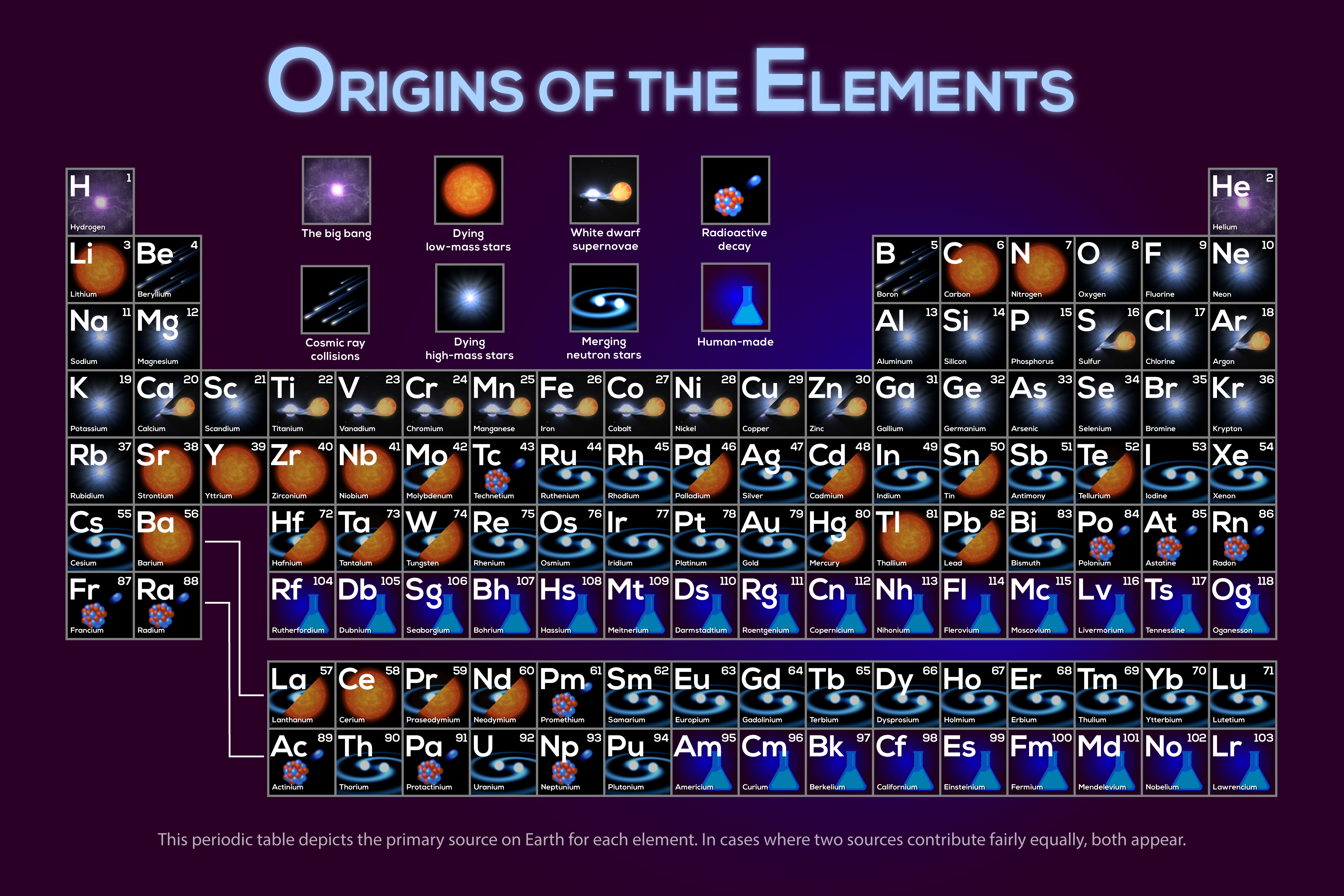
Credit: NASA's Goddard Space Flight Center; Illustrators – Scott Wiessinger & Ashley Balzer
Heavy elements in the universe and on Earth are predominantly produced in explosive stellar events such as supernovae. Understanding when and how these elements formed requires investigating the rates of these explosions across cosmic time. Two important classes of these events are Type Ia supernovae and binary neutron star mergers.
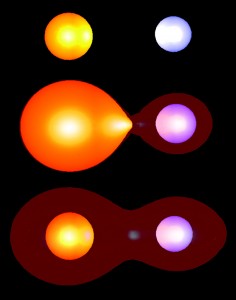
Illustration of common envelope evolution. Credit: Adrian Potter
Type Ia supernovae can occur when two white dwarfs merge in a binary system. Type Ia supernovae play a central role in chemical enrichment of our universe and are also critical tools for cosmological distance measurements. Additionally, binary neutron star mergers are critical for the chemical enrichment of the universe. These events are believed to share a similar evolutionary stage as some Type Ia supernovae, namely, common envelope evolution.
To constrain the formation, physics, and frequency underlying Type Ia supernovae and binary white dwarf mergers (and their shared common envelope evolutionary stage) this project models the evolution of large populations of binary star systems using a rapid binary population synthesis code called COMPAS. Through these simulations, we are able to compute the resulting merger rates of binary white dwarfs and binary neutron stars. The scale of the populations within the simulations are unique tools for connecting uncertain stellar and binary evolution physics to observable supernova rates and for assessing the impact of model assumptions on predicted event rates.
Contact
Melanie Santiago [she/her/hers]
University of Califronia, San Diego: Department of Astrophysics & Astronomy
This is bold and this is strong. This is italic and this is emphasized.
This is superscript text and this is subscript text.
This is underlined and this is code: for (;;) { ... }. Finally, this is a link.
Heading Level 2
Heading Level 3
Heading Level 4
Heading Level 5
Heading Level 6
Blockquote
Fringilla nisl. Donec accumsan interdum nisi, quis tincidunt felis sagittis eget tempus euismod. Vestibulum ante ipsum primis in faucibus vestibulum. Blandit adipiscing eu felis iaculis volutpat ac adipiscing accumsan faucibus. Vestibulum ante ipsum primis in faucibus lorem ipsum dolor sit amet nullam adipiscing eu felis.
Preformatted
i = 0;

while (!deck.isInOrder()) {
    print 'Iteration ' + i;
    deck.shuffle();
    i++;
}

print 'It took ' + i + ' iterations to sort the deck.';